BIOFILM
WHAT IS BIOFILM AND WHAT ARE THE RISKS?
UNDERSTANDING THE ROLE OF BIOFILM
Bacteria often work together as a community, and biofilm formation is one outcome. But why do they create these biofilms?
Like all living organisms, bacteria need food, water, and the right environment to grow and survive. Competition for nutrients is intense, and they must protect themselves against hostile conditions in the host or toxic substances that can kill them during the planktonic (free-living) stage.
HOW DOES A BIOFILM FORM?
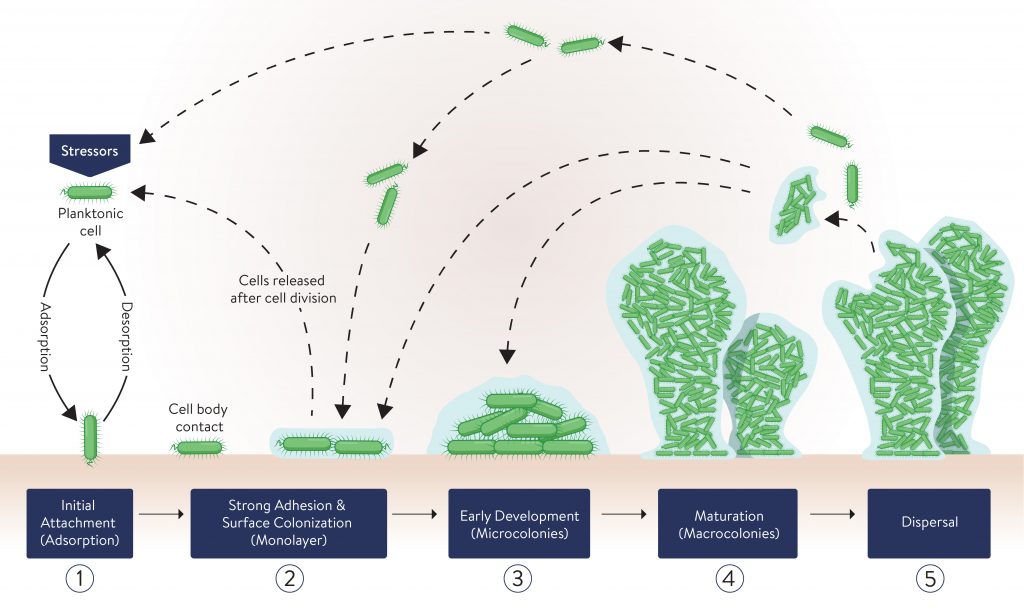
Biofilm development is highly organized, involving intercellular and intracellular signaling. During this process, specific genes and proteins are upregulated or downregulated to enable bacterial attachment to host cells. Biofilms can form within 24 hours after initial attachment. Formation and spread occur in five main steps (see Figure 2). After attachment, bacteria create a monolayer and produce a protective polymeric matrix. In the final stage, parts of the mature biofilm detach, dispersing as planktonic cells that can initiate new biofilms elsewhere in the body (Guzmán-Soto et al., 2021).
BIOFILMS AND THE HOST IMMUNE SYSTEM
In short, biofilm formation is a survival strategy and defense mechanism for bacteria. It is extremely difficult to eradicate biofilms using commonly available tools, and the animal’s immune system cannot detect or phagocytose bacteria within a biofilm (Prakash et al., 2003).

Initial infection
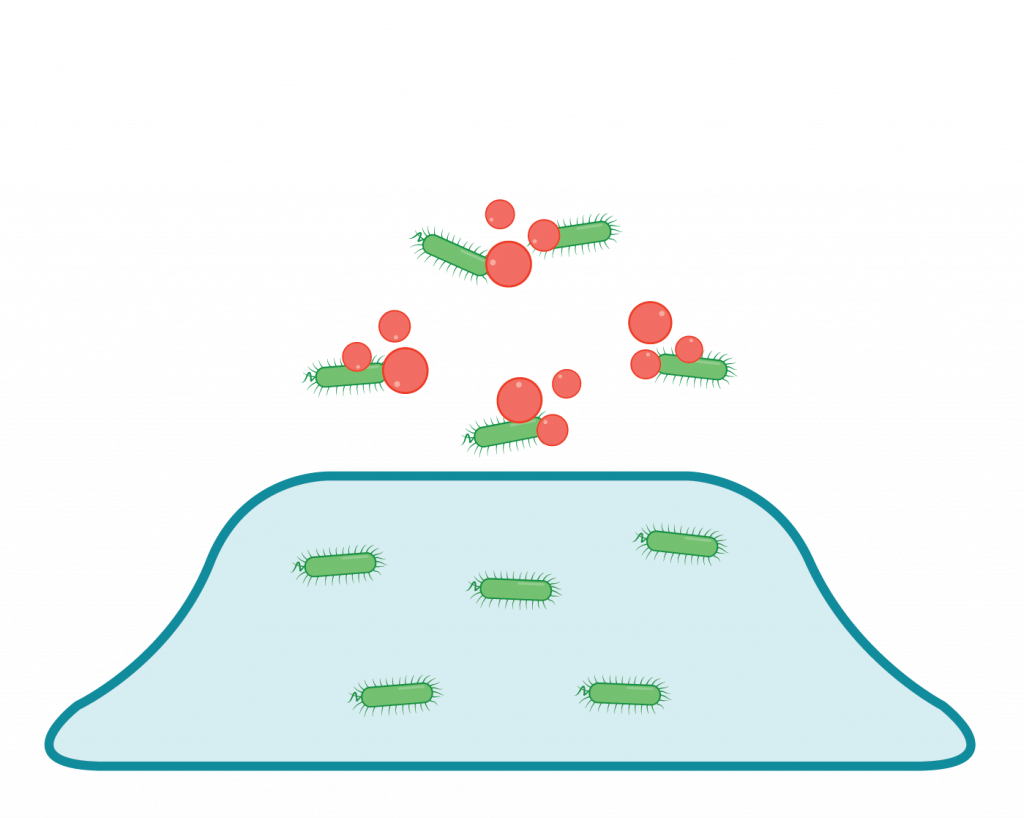
Bacteria invade the host causing infection, and form an extracellular structure – biofilm.
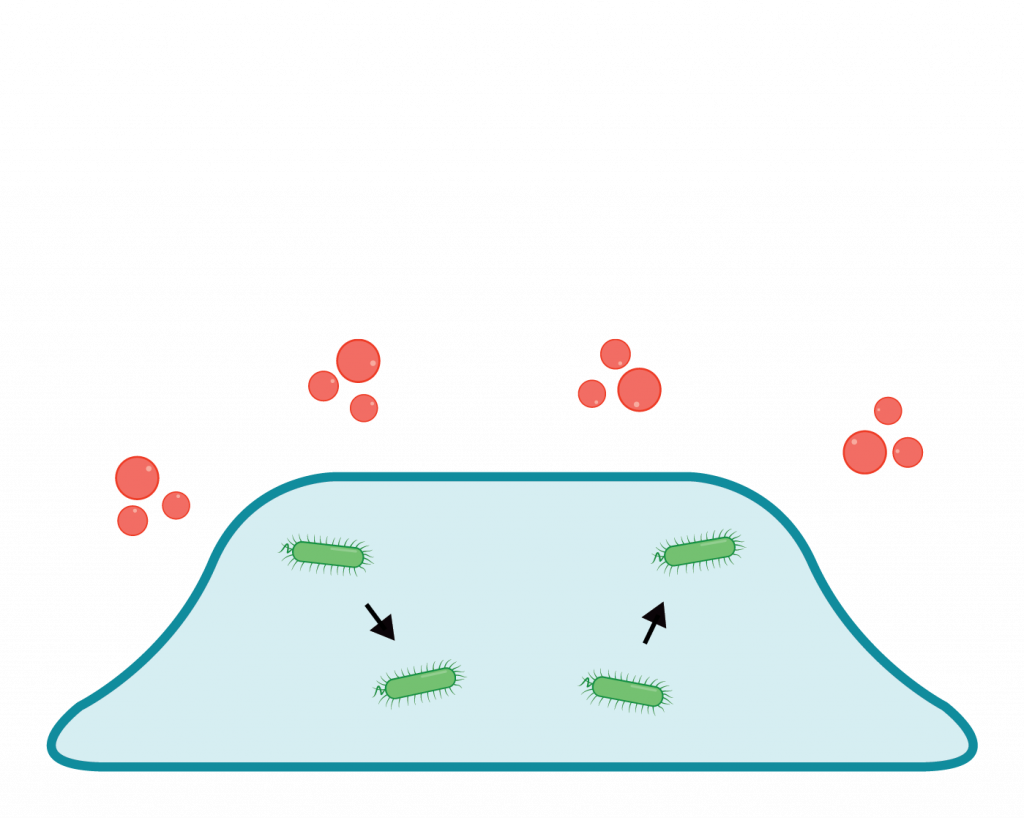
Dormant period
Biofilm “protects” the bacteria inside as it is impenetrable to antibiotics and immune cells.
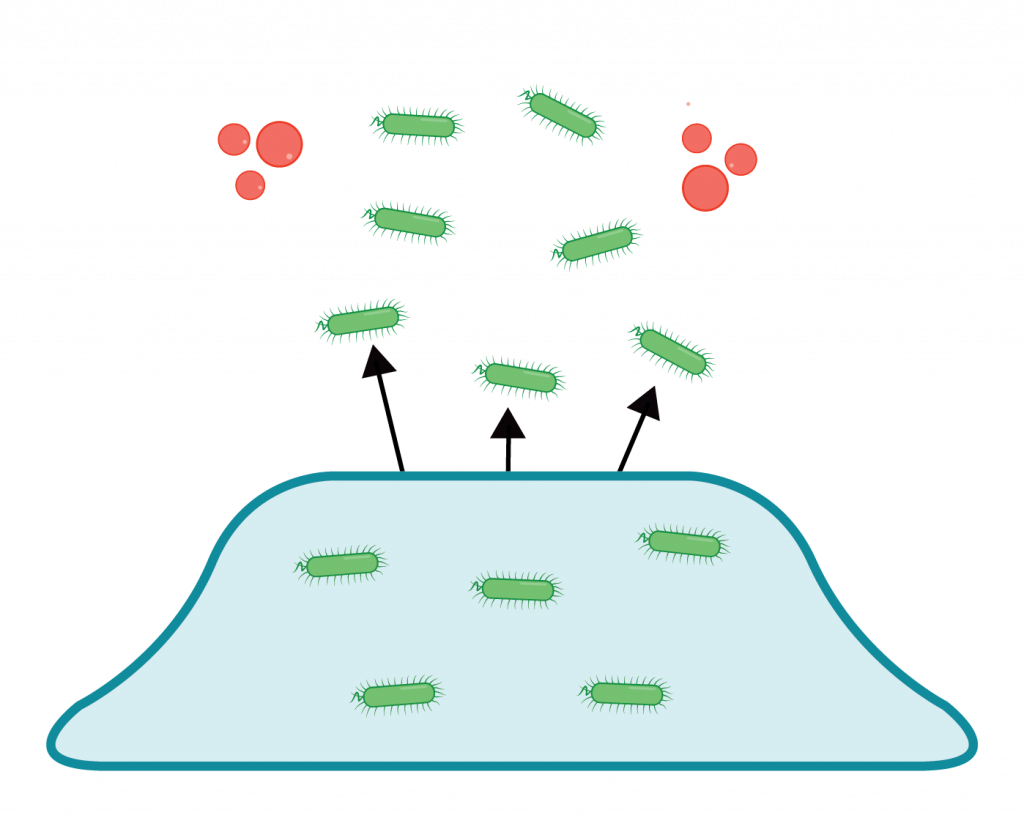
Chronic infection
Upon reaching sufficient population, bacteria in biofilm reoccur in planktonic state and cause recurring infections.
Figure 2:
This means the animal’s immune system is triggered only by planktonic bacteria, not those hidden within biofilms. Under stress, the immune system becomes suppressed, increasing the risk that bacteria from the biofilm revert to planktonic form—leading to new challenges (see Figure 2).
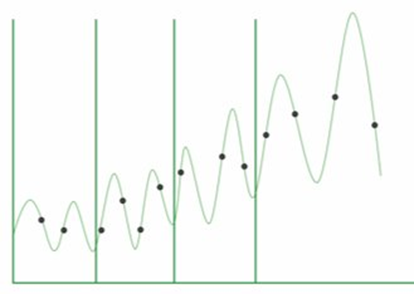
Figure 3: Recurrence of chronic infections by immune suppression in combination with biofilm formation
Chronic biofilm-related issues are observed in dairy cows, including infections caused by Streptococcus dysgalactiae, Streptococcus agalactiae, Streptococcus uberis, and Escherichia coli (M.B. Melchior et al., 2006). In swine, pathogens such as Streptococcus suis (Yang Wang et al., 2018) and Clostridium perfringens (Charlebois et al., 2014) are implicated, while in poultry, Avian pathogenic Escherichia coli (APEC) is a concern (Kushal Grakh et al., 2022). To keep animals healthy, biofilm formation must be prevented.
BIOFILM IN RELATION TO ANTIMICROBIAL RESISTANCE (AMR) DEVELOPMENT:
Due to the dense polymeric matrix of biofilms, antibiotic penetration is limited, creating a gradient below bactericidal levels and accelerating microbial resistance (Philip S. Stewart et al., 2002; Niels Høiby et al., 2009). Subinhibitory antibiotic concentrations can even enhance biofilm formation (Kaplan, 2011). Approximately 80% of chronic and recurrent infections are linked to bacterial biofilms, whose cells are 10–1,000 times more resistant to antibiotics than planktonic cells (Abranches J., 2011).